
Why does the plan
keep changing?
When to commit, what to leave open, and how to judge a late exception.
Brandon Whitmore · September 15, 2026
A production schedule tells several groups what they can count on. Purchasing orders material against it. Supervisors arrange people around it. Customer service makes promises from it. Changing a line in the schedule can undo decisions that are no longer visible in the planning screen.
Yet refusing to change can be just as costly. A machine fails. A customer cancels. A new order fits an available slot and uses material already on hand. A rule that treats all three as violations of planning discipline will eventually lose credibility.
The question is why revisions are necessary, and how much of the business should move with them. My position is that a plan should become progressively more committed as people act on it. Different decisions need different boundaries. Inside those boundaries, new information still matters, but changing an existing commitment requires a reason proportionate to its consequences.
Before setting a freeze, identify what is moving the plan
Three different problems can appear as the same daily rescheduling exercise.
The situation changed. A supplier misses a confirmed delivery, demand changes, or equipment becomes unavailable. The earlier plan may have been reasonable with the information available then. Better discipline cannot eliminate all of this uncertainty.
The organization discovered something late. Inventory was recorded but unusable. A routing time was wrong. An order appeared twice. A customer commitment reached production after the schedule was released. Today's revision may be necessary. The investigation should distinguish a newly detectable problem from an avoidable error or a delay in passing on information already known.
The planning method generated the movement. Moving the end of the planning horizon can change batch decisions nearer the beginning. An optimizer can select a different sequence without recognizing the work already done to support the previous one. A model with several similarly good solutions has little reason to preserve yesterday's choice unless that preference is represented.
This last problem predates modern AI. Blackburn, Kropp and Millen's 1986 study examined instability arising from lot sizing and a rolling planning horizon while deliberately excluding demand and supply uncertainty. The planning process itself could generate disruption. Management Science
It remains relevant. A 2025 study using NXP semiconductor data describes how alternative optimal solutions can contribute to changing plans despite fairly stable inputs. Its simulation improved stability with a stochastic planning approach while maintaining comparable inventory and delivery performance. That is evidence from a modeled industrial setting, not proof that changing algorithms will fix any factory's schedule. Weijers and colleagues, Winter Simulation Conference
These causes need different remedies. Genuine uncertainty may justify options and contingency capacity. Avoidable late discovery calls for better information and coordination. Instability created by the planning method calls for changing its objectives, constraints, or treatment of prior decisions. A longer freeze can suppress all three on a dashboard while leaving their causes intact.
In one planning review, I reconstructed 617 archived daily plan files because the live workbook overwrote its history. That restored a record of what had changed as execution approached. A record of revisions does not, by itself, establish why they occurred. To answer that question, a business also needs to know when the triggering condition arose, when it became known, and when planning received it. The gap between those times separates uncertainty from information arriving late.
Freeze the commitments people need to rely on
“The next three days are frozen” leaves several questions unanswered. Does that fix production quantities, product families, job sequence, staffing, or customer delivery dates? Does filling an unused slot count as breaking the freeze? Can a quantity change within an already planned run?
I have used a 72-hour change freeze with an escalation route for reprioritization. That is an operating rule, not evidence that 72 hours is the correct boundary elsewhere.
A more useful starting point is the decision someone must make before execution:
| Commitment | What makes reversal costly | What may remain adjustable |
|---|---|---|
| Material purchase | Supplier amendment deadlines; custom material already produced | Allocation of interchangeable stock |
| Staffing | Shift notice, overtime arrangements, required skills | Work assignment within the available crew |
| Production setup | Tooling, cleaning, preparation, or material staging | Quantity within a compatible run and available capacity |
| Customer promise | A delivery commitment on which the customer relies | Internal routing that preserves that commitment |
These are examples to map locally, not fixed rules. An interchangeable component and a customer-specific finished item do not lose flexibility at the same rate.
Research already offers a concrete version of selective freezing. Meistering and Stadtler's hierarchical planning system fixes setup decisions within the week while allowing daily quantities to change. Their stabilized-cycle strategy additionally preserves a product's cycle while its service level remains under control. The experiments use a restricted single-machine setting, so they do not supply a ready-made policy for a complex network. They do show why “frozen” need not mean every decision is locked. Business Research
The forecast can continue to update throughout. So can actual inventory, equipment status, and quality information. A fixed decision and an updated view of reality can coexist. When reality makes the decision infeasible, the task becomes repairing the affected commitments.
Choose the boundary where waiting starts to cost more than it helps
Waiting has value when useful information is still arriving and the business can act on it. Committing has value when suppliers, crews, and equipment need dependable instructions. The boundary belongs where those two considerations meet, which may differ by product, resource, and type of decision.
For one production run, material may need commitment before the supplier's amendment deadline, staffing before shift notification, and sequence before tooling preparation. Those deadlines bound how long each choice can remain open. They do not, by themselves, establish the best cutoff; committing earlier may still be worthwhile when it improves coordination more than later information would improve the decision.
To choose it, reconstruct a sample of revisions using only the information available at each decision date. Locate the consequential deadlines: when material became noncancelable, shifts were arranged, preparation started, or promises were made. Then test candidate boundaries against both disruption and missed opportunities. Counting revisions alone rewards a policy for refusing to respond.
Historical outcomes cannot simply be assigned to a different freeze policy: changing today's sequence changes tomorrow's available capacity. A rolling simulation can compare policies through those consequences before a limited operating trial. Its credibility depends on representing the constraints and delays that actually forced revisions, including costs the original planning model omitted.
A May 2026 sales and operations planning study illustrates the problem. Longer frozen horizons improved some stability measures, but sales volumes fell and delivery times lengthened, with broadly stable profit. Its policy prohibited new orders inside the frozen window even when capacity was available. The experiments also changed the overall planning horizon and linked customer patience to the freeze length, so they do not isolate a pure freeze-duration effect. The result is a warning about what a stability measure leaves out. Abay, Kaihara and Kokuryo, International Journal of Automation Technology
The evaluation also needs the buffer policy. Spare capacity, interchangeable inventory, and alternative routings affect what the operation can absorb without breaking commitments. An August 2026 preprint found that adding initial inventory buffers could reverse the relative cost performance of stochastic and deterministic planning in its simulations. The planning method's performance depended on the protection already available in the operating system. Schlenkrich and colleagues, version 3
This suggests testing the freeze together with the operating conditions that support it. A boundary calibrated during steady demand may need reconsideration during a launch, phase-out, or supplier failure.
Which late changes are worth making?
There is a strong case for leaving some decisions open. Forel and Grunow's work on evolving forecasts finds value in anticipating later updates and retaining production flexibility. The benefit depends on capacity, uncertainty, and the structure of the updates; it does not imply that every forecast revision should trigger a new schedule. Production and Operations Management
Consider a late order that fits unused capacity, shares an existing setup, and consumes otherwise stranded inventory. Accepting it may improve the operation with little disturbance. Consider instead an order that displaces three promised deliveries, adds a cleaning cycle, and requires overtime. Its margin alone is a poor basis for accepting it.
The comparison should use the same updated information on both sides. If the current plan remains feasible, compare continuing it with the proposed change. If a breakdown has made it impossible, compare feasible recovery options. There is no value in defending an obsolete baseline that can no longer be executed.
Physical feasibility, qualification requirements, and binding service commitments come first. For the choices that remain, include the consequences across the affected work: additional setups, scrap, overtime, expediting, delayed orders, and capacity consumed that may be needed later. Some changes will justify extensive rescheduling. Others will justify only a local adjustment.
A small calculation shows why the size of the revision matters
The accompanying example uses six invented jobs on one machine. Job F's due date moves earlier, from hour 15 to hour 7. All work is still unstarted. Due dates are soft targets with lateness penalties, so retaining the old plan remains feasible.
The calculation examines all 720 job sequences. Operating cost includes weighted lateness and changes between product families. A separate change cost assigns nine illustrative units to each job-hour by which the other five jobs' start times move. F's requested advancement receives no disruption charge. These are invented coefficients, not plant estimates or dollars.
| Response | Operating cost | Change cost | Total | F completes |
|---|---|---|---|---|
| Keep the original plan | 42 | 0 | 42 | Hour 13: six hours late |
| Choose the lowest operating cost | 8 | 36 | 44 | Hour 2: on time |
| Choose the lowest total including change cost | 32 | 9 | 41 | Hour 11: four hours late |
The larger revision delays four other jobs by an hour each. The smaller revision delays only one job by an hour and produces the lowest modeled total. It reduces F's lateness without meeting the new target. If hour 7 were a binding deadline, both the smaller revision and the unchanged plan would be inadmissible.
The smaller revision's one-unit advantage over leaving the plan alone is also thin. In practice, uncertain cost estimates could easily reverse that choice.
Changing the assumed disruption penalty changes the answer. At six units per shifted job-hour, the larger replan is best. At nine, the smaller revision is best. At twelve, keeping the original plan is best. Each result is checked against all 720 sequences.
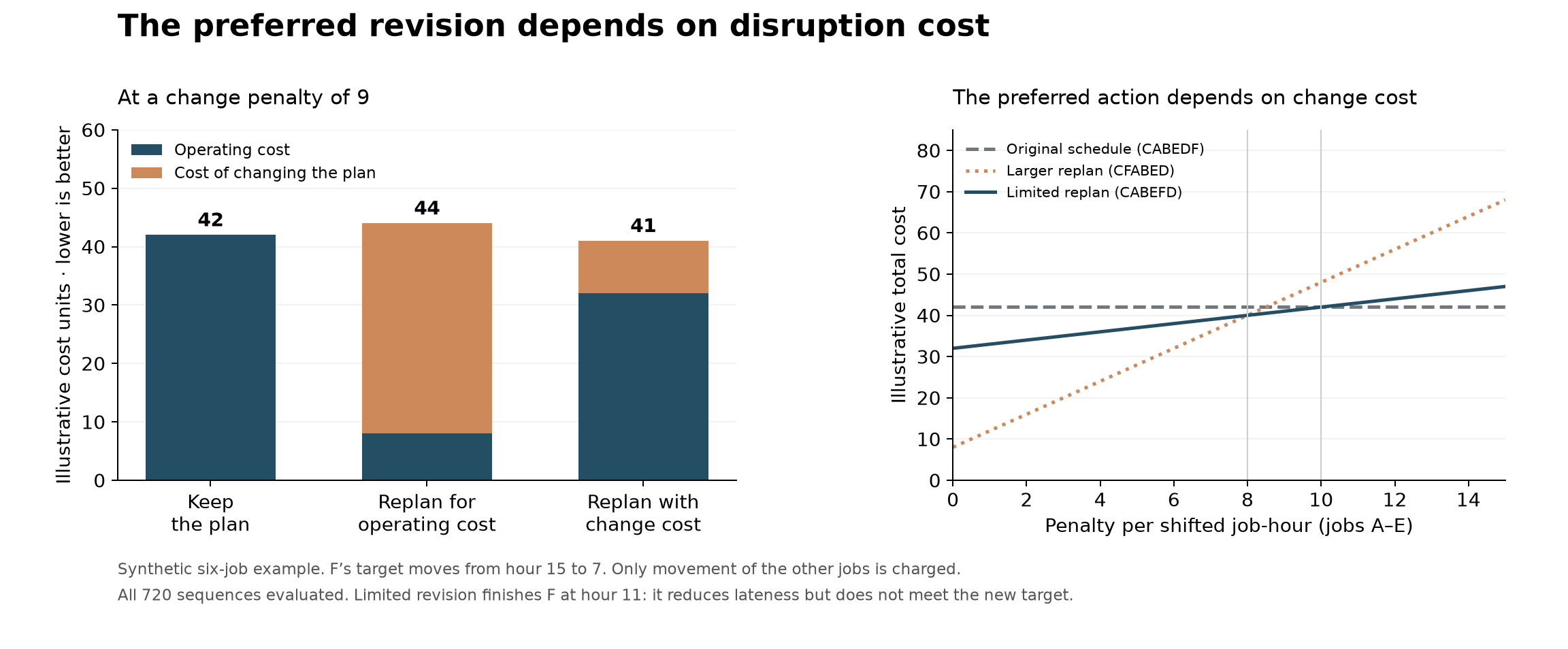
Synthetic illustration. The right panel compares three fixed candidate schedules as the change penalty varies. The model excludes hard deadlines, supply shortages, failures, and future arrivals. It illustrates a tradeoff; it does not estimate a freeze duration. Method and source code · Results
Make exceptions explainable
A practical freeze policy should state the commitment being protected, the flexibility still delegated to the planner, and who can authorize displacing someone else's commitment. Routine adjustments within that flexibility should not require an executive meeting. Changes beyond it should make the displaced work visible to whoever decides.
Each exception should also preserve its trigger. A missed supplier delivery, an inventory correction, and a commercial reprioritization may all lead to the same schedule edit; combining them under “urgent” makes the record almost useless for improving the next plan. Record the cause when the decision is made, including whether the information existed before the freeze.
Over time, examine recurring causes alongside delivery performance, preparation lost, additional setups, and valuable work refused. A declining revision count accompanied by missed feasible orders is different from a declining count caused by reliable inputs and earlier coordination.
A plan should become firm enough that people can act on it. It should remain open where delaying a decision preserves useful options, and allow exceptions when changed conditions justify disturbing a commitment. If the same exception keeps arriving at the same point every week, examine why. Could the information have arrived earlier? Is the commitment being fixed too soon? Or does this part of the business need capacity deliberately reserved for late changes?